

The UK’s North Sea debate often swings between absolutes—“expand” vs “shut it down.” A better lens is substitution. The question is not whether the UK will use gas during the transition (it will), but whether the molecules it uses arrive via low-emission supply chains—or via the highest-emission paths on the planet. Recent modelling suggests the UK can raise commercially recoverable reserves by roughly half and remain inside stringent climate pathways—if that extra output displaces higher-emission imports and keeps cutting its own operational footprint
What the new modelling actually shows
The topline is counter-intuitive only if you ignore supply-chain emissions. End-use combustion (Scope 3) is essentially the same wherever gas comes from. The big differences lie in Scope 1–2: how the gas is produced, processed, and transported. On those stages, domestic UK production is markedly cleaner than long-haul liquefied natural gas (LNG). That’s why the modelling can show headroom against a strict 1.5°C-aligned pathway even with more commercial reserves—provided added UK volumes replace LNG rather than simply add to total consumption.
The displacement lever (where the climate math actually moves)
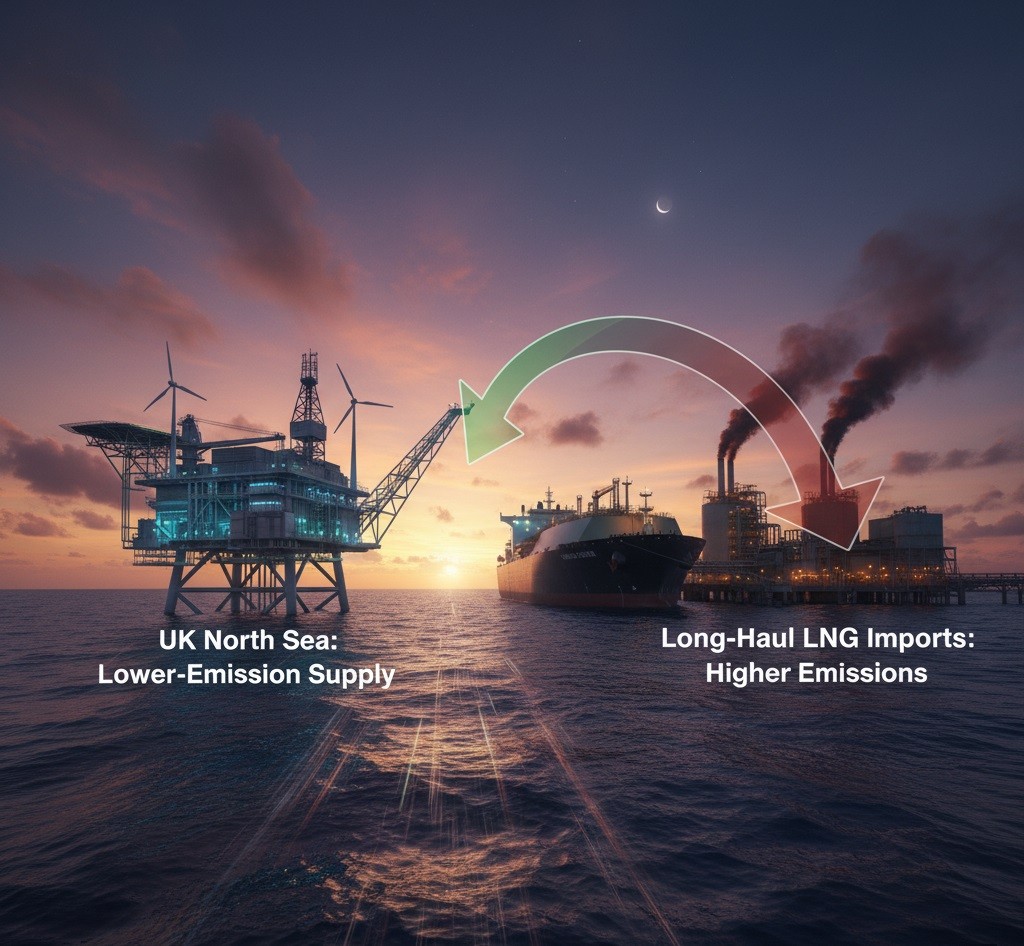
Every additional tranche of UK-produced gas that displaces US LNG avoids a sizeable upstream/midstream footprint—think liquefaction, shipping, and regasification. That avoided footprint is the core climate benefit of “more from home.” It’s not about burning more; it’s about sourcing smarter for what the UK will still use on the way to net zero.
Why intensity matters (and what the benchmarks say)
Carbon-intensity benchmarks show the spread clearly: domestic UK gas sits far below LNG on a per-barrel-of-oil-equivalent basis, with LNG roughly three to four times higher. The upshot is simple: as the UK’s import mix leans more heavily on LNG through the 2030s—especially as Norwegian pipeline flows wane—the average supply-chain intensity of the gas the UK uses is set to rise unless more of it is sourced from low-intensity domestic projects.
What “within emissions targets” really implies
“Within targets” is not a blank cheque; it’s a conditional finding:
- Added UKCS volumes must actually replace LNG in the import mix; and
- The basin must keep decarbonising operations (platform electrification, methane detection/abatement, flaring/venting reductions) so that the domestic barrel stays “advantaged” versus imports.
Miss either condition and the benefit erodes quickly.
A licensing strategy that fits the science
A pragmatic path aligns with the idea of targeted tie-backs rather than new frontiers: connect known discoveries to existing hubs while they still operate. This keeps unit emissions and costs down, extends infrastructure life, and unlocks the “substitution” benefit faster. It also squares with a “science-aligned” test for approvals: prioritise short-cycle projects with low breakevens, short carbon paybacks, and credible electrification or low-methane plans.
Delivery risks you can actually manage
- Displacement risk: If new UK volumes don’t push LNG out of the mix (for example, if demand quietly rises), the climate gain vanishes. Policy should hard-wire displacement by linking infrastructure life-extension to measured LNG backfill reduction.
- Execution risk: Without timely platform electrification and aggressive methane management, the domestic advantage narrows. Focus on fastest, highest-impact abatement (power-from-shore/offshore grids where feasible; continuous LDAR; vent-to-power projects).
- Policy risk: Investment follows clarity. Stable, transparent fiscal terms and clear “science-aligned” criteria determine whether tie-backs arrive in time to offset LNG exposure.
A pragmatic scoreboard for 2025–2035
- Import mix: Track the LNG share of UK supply. The higher it goes, the bigger the climate dividend from each unit of displaced LNG.
- Operational intensity: Track kgCO₂e/boe for domestic production. Electrification and methane projects must bend this curve down year-on-year.
- Cycle time: Prioritise projects with <5-year time-to-first-gas and low capex per boe; the sooner they flow, the sooner they displace LNG.
- Decommissioning gates: Keep critical hubs open long enough for tie-backs; once a hub is gone, the low-cost, low-intensity route to market is gone with it.
Bottom line
If the UK still needs gas during the transition—and it does for a while—the rational climate strategy is to use less overall and source the remainder from the lowest-emission supply chains. In practice, that means targeted North Sea projects that demonstrably substitute for LNG, coupled with relentless operational decarbonisation. Done right, “50% more commercial reserves” is not an argument for more combustion; it’s a blueprint for shrinking the footprint of what the UK must still use on the way to net zero.
By IES Fellow, Amro Heikal
References (no links)
- Wood Mackenzie (Oct 2025). UKCS production can remain within strict net-zero pathways with ~50% more commercial reserves; headroom vs 1.5°C pathway and import-displacement effects. Wood Mackenzie+1
- OGV Energy (Oct 2025). North Sea production can remain within emissions targets even if commercial reserves were increased by 50%. OGV Energy
- North Sea Transition Authority (Sep 2025). Natural gas emissions intensity analysis; domestic vs LNG carbon-intensity benchmarks and supply-mix impacts. ArcGIS StoryMaps+1
- UK Government (Mar–Apr 2025). Building the North Sea’s Energy Future—consultation on a science-aligned approach and licensing context. gov.uk+1
- JPT / Offshore Energy (Oct 2025). Trade-press summaries of Wood Mackenzie findings; LNG displacement and UKCS headroom narrative.